Emergency Communications Accessibility Under the EAA: RTT, Total Conversation, and the 112 Duty Explained

Most EAA compliance coverage focuses on websites, apps, and e-commerce checkouts. Emergency communications barely get a mention - yet they carry some of the most specific, time-bound obligations in the entire directive. For a deaf person unable to speak during a cardiac arrest, or a deafblind user trying to report a fire, inaccessible emergency services are not a UX inconvenience. They are a life-safety failure.
This post unpacks what "accessible emergency communications" actually means under EU law, which obligations fall on network operators versus PSAPs versus Member States, and what the compliance calendar looks like through 2027.
Why Emergency Communications Are a Distinct EAA Obligation
The European Accessibility Act (Directive (EU) 2019/882) explicitly names emergency communications to the single European emergency number 112 as an in-scope service. This is not a general digital-accessibility obligation applied loosely to a telecoms context - it is a direct, named requirement with its own legal articles and its own derogation timeline.
Two pieces of EU legislation govern this space jointly:
The European Electronic Communications Code (EECC, Directive (EU) 2018/1972) - the foundational telecoms law. Article 109(4) requires Member States to ensure that end-users with disabilities have access to emergency services that is equivalent to that enjoyed by other end-users. Article 109(5) extends that equivalence to roaming users. Commission Delegated Regulation (EU) 2023/444, adopted under Article 109(8), adds detailed measures on caller location, disability access, and routing to the most appropriate PSAP.
The EAA (Directive (EU) 2019/882) - the accessibility law. Annex I, Section IV specifies that electronic communication services must provide real-time text (RTT) in addition to voice. Annex I, Section V adds that emergency communications to 112 must be answered using the same communications means as received.
The EECC sets the equivalence principle; the EAA specifies the concrete technologies and the answering duty. Neither instrument alone gives the full picture.
Emergency communications are not covered by the general EAA web/app accessibility rules. They sit under a separate legal basis (Annex I, Sections IV–V of Directive 2019/882) with their own deadlines, their own responsible parties, and their own harmonised standard in development. Compliance teams that treat this as a footnote to their WCAG audit are missing a distinct legal obligation.
What "Accessible Emergency Communications" Means in Practice
Real-Time Text (RTT)
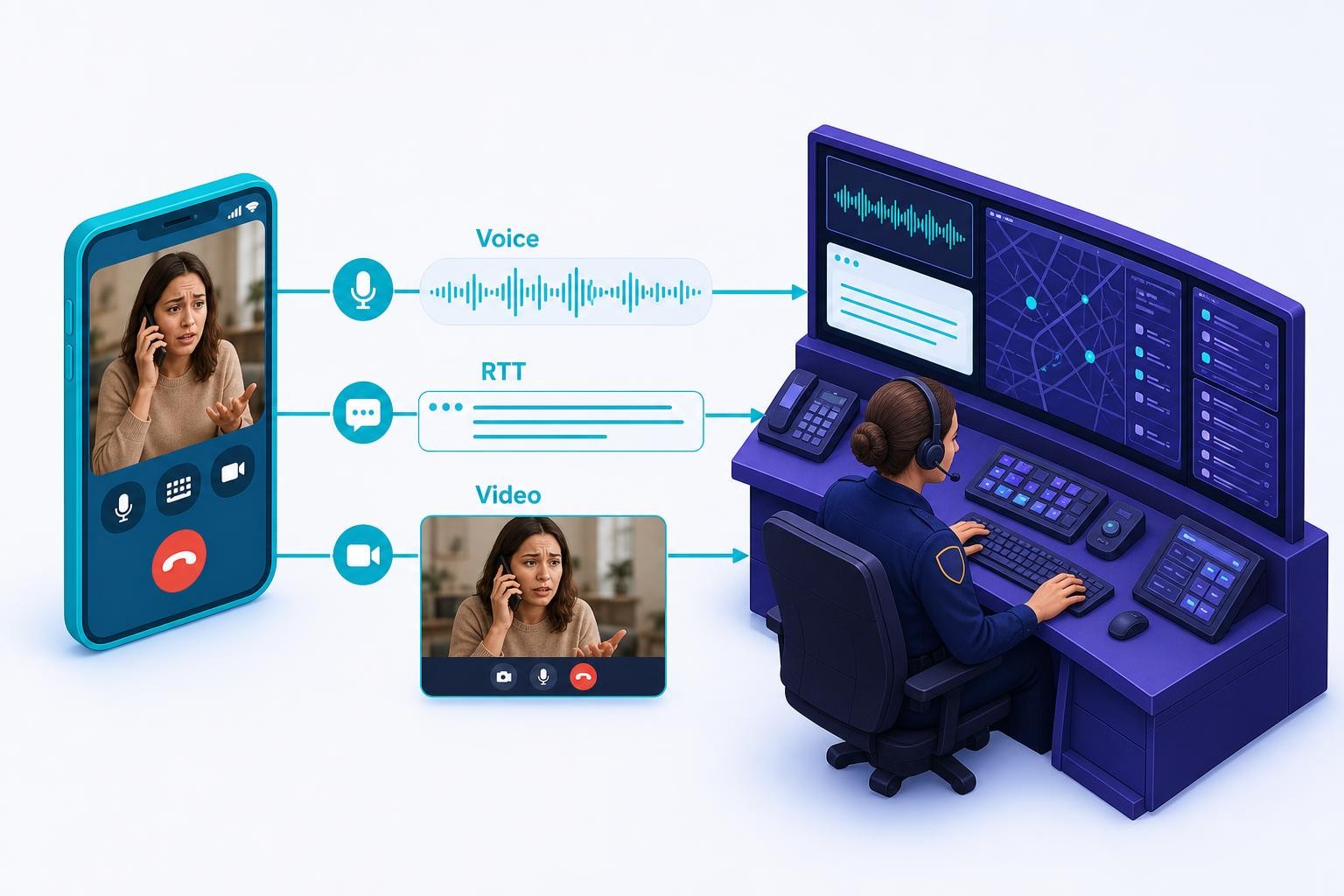
RTT is the baseline technology the EAA mandates. Unlike SMS - which sends a complete message only when the user presses send - RTT transmits text character by character as the user types, so the receiving party sees the message forming in real time. This matters enormously in emergencies: a caller can begin typing their address and the PSAP can start routing a response before the full message is complete.
For the purposes of interoperability, EN 301 549 clause 6.2 references ITU-T Recommendation T.140 as the widely used protocol for RTT coding and presentation, with IETF RFC 4103 specifying the RTP payload transport for VoIP/SIP implementations. Any ICT product that provides two-way voice communication must also provide two-way RTT over a single user connection - this is a normative requirement in EN 301 549, the harmonised standard operators test against.
RTT is not a relay service or an app workaround. EENA has confirmed that native deployment in devices and networks is the only way to guarantee full equivalence at home and while roaming - an app-based solution does not satisfy the functional equivalence requirement because it depends on a separate data connection and may not transmit caller location.
Total Conversation
Total conversation goes further. The EECC defines a "total conversation service" as a multimedia real-time conversation service providing bidirectional symmetric real-time transfer of motion video, real-time text, and voice between users in two or more locations - all three media simultaneously in a single call session. The standard was originally defined in ITU-T Recommendation F.703.
The practical significance: a deaf user who relies on sign language can use the video channel to communicate with a sign language interpreter or directly with a trained PSAP operator, while the RTT channel remains available for supplementary text. Total conversation is the closest thing to genuine equivalence for users who cannot use voice at all.
The EAA requires total conversation where video is already provided as part of the electronic communications service - it is conditional on video capability, not an absolute floor in the same way RTT is.
The Compliance Timeline: Two Hard Deadlines
The EAA set 28 June 2025 as the deadline for RTT to be operational on public electronic communications networks as a person-to-person (P2P) service, with a derogation option allowing Member States to extend the deadline for RTT as an emergency communications channel to 28 June 2027.
RTT access to the single European emergency number 112 - meaning PSAPs must be capable of receiving, answering, and processing RTT emergency communications - must be in place by 28 June 2027 at the latest.
| Deadline | Obligation | Who |
|---|---|---|
| 28 Jun 2025 | RTT operational on public networks (P2P) | Network operators / Member States |
| 28 Jun 2025 | Total conversation operational where video is provided (P2P) | Network operators / Member States |
| 28 Jun 2027 | RTT (and TC where available) must be provided to 112 / PSAPs must be able to receive and process it | Member States / PSAPs |
| 28 Jun 2027 | Service contracts concluded before Jun 2025 must comply | Service providers |
| 28 Jun 2030 | Products/services lawfully in use before Jun 2025 must be phased out | All economic operators |
The 2027 derogation for 112 is not a grace period to ignore - it is a ceiling, not a floor. As of mid-2025, only Ireland and Croatia had begun offering native RTT services before the June 2025 deadline, with the remaining 25 EU Member States yet to start. The 2027 hard stop is approaching fast, and PSAP infrastructure upgrades are complex and expensive.
The Equivalence Principle and the PSAP Answering Duty
The most operationally demanding obligation in this framework is the principle of equivalence as applied to answering. The EAA is explicit: if a citizen contacts 112 using real-time text, the PSAP must respond using the same communications means - text must be answered with text, video with video.
This is not a best-efforts aspiration. It is a legal requirement under Annex I, Section V of Directive 2019/882, reinforced by Article 109(4) of the EECC. The equivalence standard also requires that accessible means:
- Enable two-way interactive communication between the user and emergency services
- Be available without pre-registration to all people with disabilities, including those travelling from another Member State
- Be free of charge (as 112 is mandated to be)
- Transmit caller location information to the PSAP
That last point is a significant gap in current interim solutions. Many accessible communications features such as SMS, apps, and relay services may not send caller location to the PSAP, which significantly impacts accessibility for groups who may have additional difficulties describing their location.
Who Is Responsible for What
The regulatory responsibilities are split across three layers, and conflating them is a common compliance mistake.
Member States are responsible for transposing the EAA and EECC into national law, for ensuring their PSAP systems are upgraded to handle RTT and total conversation, and for meeting the 2027 deadline. They must also report roadmaps to the Commission under Delegated Regulation 2023/444.
Network operators / electronic communications service providers are responsible for deploying native RTT on their public networks (the 2025 P2P obligation) and for ensuring interoperability - including across roaming. They must also ensure that RTT calls carry caller location. The obligation to provide RTT is on the network, not on a third-party app.
ICT product manufacturers and software vendors selling into the EU must ensure their products meet EN 301 549 clause 6.2 (RTT) and the broader communication requirements. If a device provides two-way voice communication, it must also provide two-way RTT. This applies to handsets, softphones, CPE, and any intermediate ICT in the communication chain.
PSAPs (Public Safety Answering Points) must upgrade their systems to receive, process, and respond to RTT and total conversation calls. EENA urges PSAPs to begin working with solution providers now, even where the 2027 derogation applies, because upgrading PSAP systems to handle RTT alongside voice and video is an expensive and complex undertaking that requires both technical and operational adjustments, including staff training.
The Harmonised Standard: Commission Mandate M/587
Compliance with the EAA creates a presumption of conformity when a product or service meets a relevant harmonised standard. For emergency communications accessibility, that standard is still being developed.
Under Commission Mandate M/587, ETSI's TC EMTEL committee is developing a harmonised standard for the accessibility of emergency communications and for the answering of emergency communications by PSAPs, including to the single European emergency number 112. ETSI has already published a preparatory Technical Specification (TS 103 919) which serves as the basis for the forthcoming harmonised standard (to be published as EN 303 919). ETSI TS 103 919 emphasises the need for interoperability across Europe and highlights the importance of supporting multiple media forms - voice, text (including RTT), and video - collectively termed total conversation.
Until EN 303 919 is published and listed in the Official Journal, operators and PSAPs must demonstrate compliance with the EAA's functional requirements directly. EN 301 549 (the general ICT accessibility standard) remains the reference for RTT interoperability requirements on devices and software.
The Digital Networks Act: What's Coming
The European Commission adopted its proposal for the Digital Networks Act (DNA) on 21 January 2026. The DNA is intended to replace the EECC as the main EU legislation governing electronic communications, including emergency communications. For the 112 sector, the DNA largely maintains the existing obligations related to access to 112 and public warning systems while further clarifying and strengthening them, with particular emphasis on network resilience, preparedness, mandatory testing before significant network changes, and clearer guarantees for transnational emergency communications.
The DNA is still in the legislative process - the European Parliament and Council must adopt the same text, a process that typically takes two or more years. The EECC and EAA obligations remain fully in force in the meantime. Operators and PSAPs should not wait for the DNA to act on their 2027 RTT obligations.
Practical Steps for Operators and ICT Vendors
The gap between legal obligation and operational reality is wide. Here is where to focus:
For network operators:
- Audit your current RTT deployment status. Native network-level RTT (not an OTT app) is the only route to full equivalence.
- Verify that RTT calls carry Advanced Mobile Location (AML) or equivalent caller location data to the PSAP.
- Engage with your national regulator on the PSAP upgrade roadmap required under Delegated Regulation 2023/444.
- Test RTT interoperability across networks, operating systems, and device manufacturers - interoperability failures in P2P RTT will cascade into RTT-to-PSAP failures.
For ICT product and software vendors:
- Scope EN 301 549 clause 6.2 against every product that provides two-way voice communication - handsets, softphones, conferencing platforms, CPE.
- Ensure RTT and voice run concurrently on a single connection (not as a separate session).
- Prepare technical documentation demonstrating conformance with EAA Annex I functional requirements, ready for market surveillance authority review.
- Monitor the publication of EN 303 919 (the forthcoming harmonised standard under M/587) - once listed in the Official Journal, it will provide presumption of conformity.
For compliance leads:
- Map your organisation's position in the supply chain. Are you a network operator, a service provider, a device manufacturer, or a PSAP technology vendor? Each role carries different obligations under different legal articles.
- Do not treat the 2027 derogation as a reason to defer planning. PSAP infrastructure upgrades require procurement, integration, and staff training cycles that take years.
- Document your equivalence policy: how will your organisation ensure that a citizen who contacts 112 via RTT receives an RTT response?
How This Connects to Broader EAA Duties
Emergency communications accessibility does not sit in isolation. Electronic communications services are also in scope for the EAA's general service obligations - accessible websites, accessible support services (help desks, customer care), and accessible documentation. A network operator that deploys native RTT but runs an inaccessible customer portal for deaf users has not met its full EAA obligations.
The principle that runs through all of it is the same: equivalent access, not separate-but-lesser access. For emergency communications, that principle has a hard legal expression - the same means, the same channel, the same quality of service - and a hard deadline of 28 June 2027 for the most demanding part of it.
The organisations that will be ready are the ones that start the technical and operational work now, not the ones that wait for the harmonised standard to be finalised or for a national regulator to issue a formal notice.
Does the EAA apply to all electronic communications providers, including small operators?
The EAA exempts microenterprises — defined as undertakings employing fewer than 10 persons with an annual turnover or balance sheet total not exceeding €2 million — from its service obligations. However, the EECC's equivalence obligations under Article 109 apply to all providers of publicly available electronic communications services regardless of size, since they are implemented through Member State law rather than the EAA's microenterprise exemption.
Is SMS to 112 sufficient to meet the equivalence requirement?
No. SMS is not considered a functional equivalent to voice emergency communications under the EAA and EECC framework. SMS does not enable two-way interactive communication in real time, and many SMS implementations do not transmit caller location to the PSAP. The EAA requires native RTT — character-by-character real-time text — as the minimum accessible means, with total conversation (voice + RTT + video simultaneously) required where video is available on the network.
What is the difference between RTT and a relay service?
A relay service (such as a video relay service or text relay) involves a human or automated intermediary who converts between communication modes — for example, converting sign language to speech for a PSAP operator. RTT is a direct, native communication mode that transmits text in real time without an intermediary. The EAA requires RTT as a native capability; relay services may be used as a complementary or interim solution but do not substitute for the native RTT obligation.
What does 'native' RTT mean, and why does it matter?
Native RTT means RTT is implemented directly in the network and device infrastructure — in the IMS core, the handset firmware, and the PSAP system — rather than through a separate over-the-top (OTT) application. Native RTT works at home and while roaming, transmits caller location, and does not require the user to download or register with a third-party app. EENA has confirmed that native deployment is the only way to guarantee full functional equivalence.
When will the harmonised standard for emergency communications accessibility be published?
ETSI's TC EMTEL is developing the harmonised standard (to be published as EN 303 919) in response to Commission Mandate M/587. The preparatory Technical Specification (ETSI TS 103 919) was published in August 2024 and serves as the technical basis. The harmonised standard itself has not yet been published in the Official Journal of the EU. Until it is, operators must demonstrate compliance with the EAA's functional requirements directly, using EN 301 549 as the reference for RTT interoperability.
Does the Digital Networks Act change the 2027 deadline?
No. The Digital Networks Act (proposed January 2026) is still in the legislative process and has not been adopted. The EECC and EAA obligations — including the 28 June 2027 deadline for RTT access to 112 — remain fully in force. The DNA, once adopted, will replace the EECC but is expected to maintain and clarify the existing emergency communications obligations rather than weaken them.
Related reading
Accessible Payment Authentication and Identity Checks: 3-D Secure, SCA and KYC Flows Under the EAA
Strong customer authentication and ID verification are where accessible checkout and onboarding quietly break: SMS codes, smartphone-only approvals, selfie capture and timed steps. How the EAA, WCAG 2.2 and SCA fit together, and how to offer methods that do not depend on one device or ability.
WCAG 2.5.8 Target Size (Minimum): The 24px Rule, Its Five Exceptions, and the Dragging Fix Most Teams Skip
WCAG 2.2 added a 24 by 24 CSS pixel minimum for pointer targets and a single-pointer alternative for dragging. What 2.5.8 and 2.5.7 require, how the exceptions work, CSS patterns that pass, and how to apply the thresholds on iOS and Android.
Chatbot and AI Assistant Accessibility Under the EAA: Streaming Replies, Focus Management and the Widget Nobody Tested
Chat widgets and AI assistants sit inside checkout, banking and support flows the EAA covers, yet streaming responses, focus handling and launcher buttons routinely fail screen reader and keyboard users. What WCAG AA requires, how EU AI Act transparency duties interact, and a build-and-test checklist.